Sunday, October 31, 2021

Inconsequential Existence

Each of us is inclined to believe that our existence matters—at least to ourself, if not to others. This is a way we may express that we want meaning in our life. Each of us naturally feels that our life has some significance; that it matters, if only because we are inclined, from our perspective, to believe that the universe revolves around us. We seem to be at the center of it all. That is the natural way we perceive our world.

In fact, that is the perspective of most creatures—particularly those who do not enjoy the attributes of a developed consciousness that we humans have. We, unlike other animals, have the ability to imagine getting outside ourselves, to take a more objective view of things. When we do so, we can do a pretty good job of understanding that other creatures—particularly those with a less developed consciousness—have a much more confined view of reality. Nonetheless, we can't help but view our world from a self-centered perspective.


If we ponder the vastness of the universe, however, we are forced to conclude that our individual existence is not at all of consequence to it. Consider first the physical scale of the universe. I am but one individual among billions (even trillions) of beings on planet Earth. Earth is but one planet among several that orbit our sun. Our sun is but one star among billions in our Milky Way Galaxy. Our galaxy is but one among billions of such galaxies in the universe. Add all those multiple billions up, and you can see that each of us is an infinitesimal physical snippet of our universe. So how can I be at the center of it all? How can I be of any consequence to this mind-boggling cosmos?


Let me demonstrate the minuscule nature of our existence even further: now in the time dimension. How does my life span compare to the age of the universe? I might be lucky enough to stick around for about 80 Earth years. The planet has been here for some 60 million times longer than that. And the universe has been around for about 170 million times longer than that. But my life gets even more negligible, if I peer into the future and come to understand that the universe is at present in its infantile stage. It may be almost 14 billion years old, but some astronomers estimate that our universe may last some 100 trillion years! It's just getting started. So, from a spatial or temporal point of view, my existence is so vanishingly small as to be completely inconsequential to the universe. I am not at the center of it all. 


So, what do I make of my insignificant relevance to the cosmos? To some people, this can appear to be a nihilistic message—my life is nothing... it is meaningless. I disagree. It's only meaningless if I have bought into the message that the universe was created solely for the pleasure of mankind—which is an extremely limited and self-centered point of view.


Rather than believe that I am at the center of it all and then feel devastated when I come to see that I'm not, I think it's far more meaningful to understand that I'm blessed to be a conscious part of something so vast and magnificent and to be able to know that. Let me celebrate my being here, and my ability to comprehend its majestic nature, even if I'm an inconsequential part of it all.


The next posting will consider my existence from the other side of the coin: If I am an inconsequential part of he universe, how can my life matter... at least to me, and what do I do about it?.

Tuesday, October 19, 2021

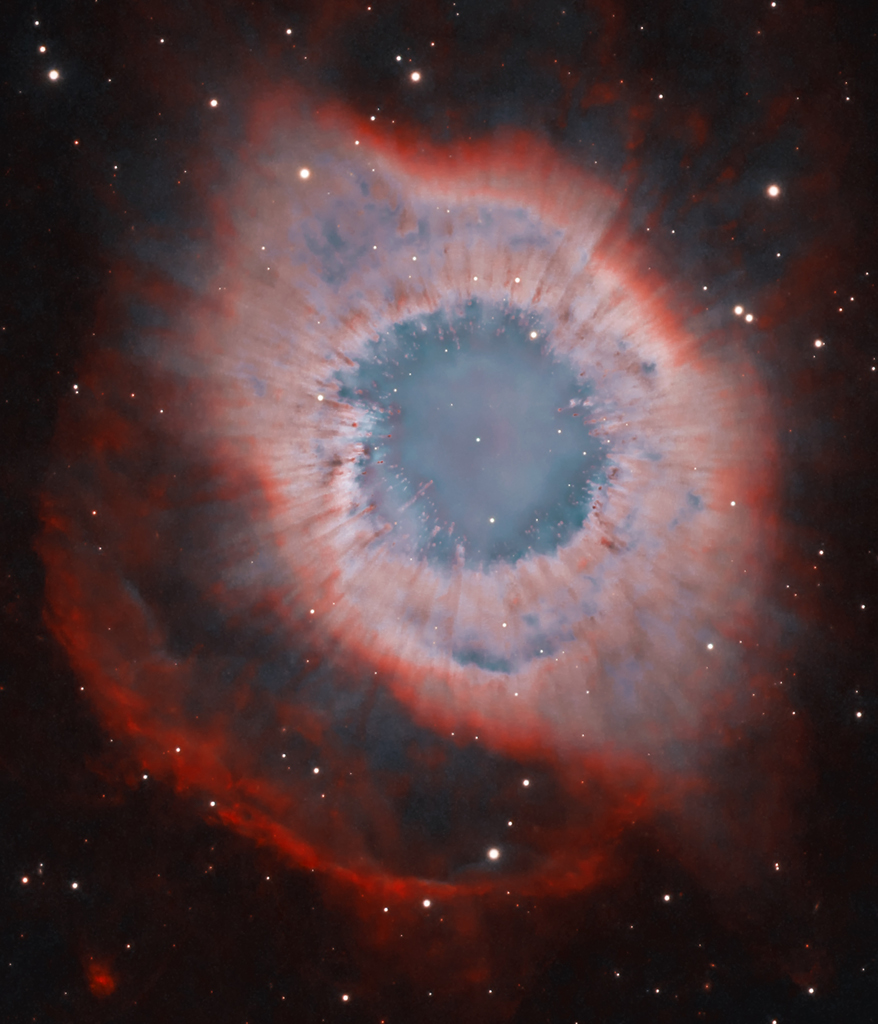
Helix Nebula

 See Explanation.  Clicking on the picture will download
the highest resolution version available.

This gorgeous photo of the Helix Nebula--a planetary nebula--is some 700 hundred light years from Earth. The white dot in the center is the star that blew up to create the nebula, which looks like an iris. (NASA) 

Sunday, October 17, 2021

Inequality Incongruences

One of the more troublesome aspects of human societies is the persistent inequality that is present in most cultures—some worse than others. Prior to our settling down into settled, agrarian enclaves, some 10-12 thousand years ago, human communities were far more egalitarian. Hunter-gatherer bands were inherently more equal, as all members contributed their labor. Hierarchies came into existence after permanent settlements were formed and people began to acquire more things. Mechanisms for division of labor and power surfaced and began to establish different degrees of control and authority.

Inequality has plagued humanity ever since. Hierarchy has created societies in which some members are perpetually held down, into classes that are considered inferior. Others have assumed superior positions, which they then come to regard as their rightful place.


The hierarchical and oppressive nature of societies has swung from extremes of outrageousness to some degree of moderation—depending on who holds power; whether it's the elites or the masses. The poor have occasionally prospered, usually following disasters or revolts against the rich. Thus the pendulum of the degree of class and inequality has often swung from one side to the other.


For example, a century ago the severe inequalities of the late 19th and early 20th centuries led to the Great Depression of the 1930s. After recovery and including the effects of World War II, economic disparities were significantly reduced for a few decades. Many people on the lowest socioeconomic levels enjoyed a period of moderate comfort, as many of them moved into middle class lives.


Since about the 1980s, however, the pendulum has swung the other direction, as the wealthy classes have once again dramatically increased their assets—creating another period of extremely high degree of inequality once again.


If people the world over were to be surveyed, I believe that the majority of them would likely agree that inequality has both increased and is widespread today. Even many of the powerful and rich would agree. Most people would probably also maintain that inequality is harmful. But that's where a consensus would end.


Strong disagreement would quickly appear if people were asked about specifics of inequality, such as: (1) how did it come about?, (2) how unjust is it?, (3) what could be done to create more egalitarianism?, (4) is the current (or any) level of inequality acceptable?, (5) do some people deserve to be poor, by having brought their poverty on themselves?, etc. Maybe the lack of agreement is partly responsible for the persistence of inequality: there may be wide concurrence that it's harmful, but little consensus on what to do about it. Some people feel it's inevitable, some are seemingly ignorant of its scale, and a few are even quite content with it. Does it need to get even worse, before enough people rise up and insist upon change?


Monday, October 4, 2021

Corporate Command

Half a millennium or so ago, businesses were small, and usually in the form of partnerships. A business was begun by the parties investing their own money, or from loans. If the enterprise failed, the partners suffered the direct consequences—either losing their money or sometimes going to jail.

Larger business enterprises were needed in the West by the 17th century, because governments could not finance all the adventures that they desired—such as expansion into colonial domains. The first corporations were formed at that time; such as the Dutch and English East India Companies. These entities were chartered by the state, and were expressly restricted to entering into market efforts for public purposes only. So the state held considerable power over corporations, to be sure that their ventures were for the good of the people.


In order to promote the creation and success of these first corporations, the state granted them considerable political and military power, in order to protect their investments in far-off lands. The money to establish a corporation was raised from wealthy investors, who then realized large profits from these lucrative enterprises. Unlike partnerships, the charter of corporations contained limited liability provisions—that protected the investors from failure of the venture. The corporation might become bankrupt, but the shareholders were not financially liable—at the worst they would lose their initial investment.


Due to this support from the state, these first corporations often were very successful. The markets established in India and other Eastern countries earned their shareholders enormous gains—to a large extent due to their political and military power that they wielded over those weaker states.


By the 19th century, corporations had gained sufficient power to begin to be able to influence laws back in the home country. Some of those laws allowed corporations to enter markets that no longer had to conform to public needs. In this way they accrued ever greater profits and power, which allowed them to become increasingly independent of the state.


Into the 20th century the conflicting demands of corporate shareholders, boards, management, and employees brought about a jockeying between these various interests. By mid-late century, corporate boards began shifting priorities to the needs of shareholders and management (thus away from employees and the public), when they began to link management’s pay to the share price and profits.


This gradual accumulation of ever-greater corporate power encouraged risk and entrepreneurial adventures, which allowed corporations to become the behemoths that are now often international in nature and beyond the control of any state. Today corporations command almost unlimited power, no longer needing even to consider the needs of citizens—let alone their employees.


Tuesday, September 28, 2021

As-If Attitude

Zhuangzi was a sage who lived some 2400 years ago in China, in what is called the Warring States era. It was a time when the previous benevolent dynasty (the Zhou) had collapsed into several petty states, which for several hundred years fought among themselves, creating instability and chaos. Several sages offered their suggestions about how to return to peaceful and just times.

Probably the most well-known Chinese sage was Confucius, who advocated a ritualistic way for people to return to refined and honorable behavior. He maintained that if society's leaders practiced moral rites and modeled them for ordinary citizens, society could become more pleasant and gracious once again. 


Many people consider Confucius to have taught rote rituals, that seem artificial and hollow. Michael Puett, a Chinese scholar at Harvard, has a very different interpretation. He points out that Confucius' real intent was to conduct rituals “as-if” the repetitive (and sometimes pointless) motions that one performs could actually lead to magical or transforming results. It wasn't the belief that mattered, or its results—it was mindfully adhering to an honorable rite, that over time brought about a peaceful and ethical life. The process itself can be transforming. If we behave as-if it's true, we open to new possibilities.


A few hundred years after Confucius, Zhuangzi came onto the Chinese Warring States scene. Michael Puett describes Zhuangzi as another as-if teacher. Here's why. One of the witty and edifying stories that Zhuangzi told was how he one day awoke from a dream, during which he had imagined himself to be a butterfly. The fascinating aspect of his tale was that he wondered if he had been Zhuangzi dreaming of being a butterfly, or if he really was a butterfly dreaming that it was Zhuangzi. What was real?


Puett points out that Zhuangzi used this riddle to teach the value of empathy. The Chinese sage suggested that we might try to imagine what it would be like to be a butterfly—as-if we could put ourself in the shoes of a butterfly. That is a huge challenge—and maybe even impossible—but it could help us find ways to begin to understand what it would be like to step into our human adversary’s sandals. We could benefit from putting effort into trying to imagine how the opponent might perceive the world—to do it as-if we could. This attempt can open us up to others' perspectives, will break us free from our narrow viewpoints, will draw us closer together, will promote respect, and thus can lead to a culture of peaceful and moral behavior. Ancient teachings coming from a very different culture and situation are still relevant today.


Wednesday, September 22, 2021

Misperceptions of Being Separate

There is a fundamental discrepancy between Western and Eastern perceptions of the way in which each of us exists, relative to the rest of the universe. While those of us in the West tend to view ourselves as individual entities that stand apart from creation, people in the East see themselves submerged into a unitary whole. While we in the West are comfortable with our unique separateness, those in the East take comfort in feeling connected to it all. While we prize our distinctiveness, they value their community.

This sense of distinctness and independence is strong within us Westerners. We absorb it from our culture and come to accept it as a given. The concept permeates our social and political lives. We come to see ourselves as distinctive and different individuals. We are oriented toward personal goals of success and achievement. We seek equality in personal relationships, or, alternatively, to be in a superior position in hierarchical relationships.


In contrast, people in the East do not like to stand out from the crowd. Rather than seeking personal accomplishments they value harmonious social relations. For example, there is no word for “individualism” in Chinese; the closest the language comes is the term for “selfishness.”


This significant difference between Western and Eastern perspectives is largely responsible for how a Westerner struggles with Eastern religious perspectives that describe a oneness to everything. Buddhism expresses our Western feelings of separateness from the universe as an illusion. Some in the West might talk about being “one with it all,” but that often comes from a limited, new-age interpretation.


I became a student of Buddhism a few decades ago, and have benefited from bringing meditation and mindfulness into my life, but I still struggle with understanding how I may let go of my Western image of being separate from it all. It's just too ingrained within me. It’s too easy to convince myself that I may intellectually comprehend my unity with it all, but deep in my gut I can't help but feel separate... often even isolated.


A recent idea came to me in meditation, that may help me feel more a part of it all, but it may well take a while for me to own the concept. All of my perceptions of myself or the world—my very understanding of existence—culminate in electrical signals in my brain. When I view a tree, photons enter my eye, impinge upon receptors on my retina, which send electrical impulses to my brain.  My total perception of the tree is that set of signals.


Similarly, sound wave vibrations are funneled into my ear canal, tickle three little bones in my middle ear, which induce vibrations on my cochlea, which then get transformed into other kinds of electrical signals in the brain. It's the same with my other three senses—taste, touch, and smell. All of them create certain specific electrical signals in my brain. Thus my view of the world is in reality nothing more than a complex field of neuronal impulses in my cerebral matter. It's literally all in my head.


So, am I really separate from that bird I hear singing outside? I know its song is “out there,” but my perception of it ultimately culminates in those electrical signals in my brain. That's all I really know about the bird. Even if I see what seems to be a separate feathered being perched out on that limb, that sense of vision ends up as yet another set of electrical signals. I own those signals. In a sense, that bird is now inside me... is a part of me. Is this fundamentally any different from a tingle I feel in my toe—a sensation that ends up as just another set of neuronal impulses? All I can know of either my toe or the bird's call is how my brain interprets those signals. Aren't they all a part of me? Am I not a part of it all?


Friday, September 17, 2021

Dismal Discovery

[Notice: The following story is fictional. I confess that I fabricated it. Nonetheless, something like it could happen some day—so maybe the reader could consider it as a science fiction warning to human beings: that they may be blithely headed toward catastrophe.]

In the year 2050 a spacecraft departed Earth for the planet Oasis, which orbits the star Alpha Centauri—a little over four light years distant. Back in 2025 Oasis was discovered, and it created great excitement, because it seemed almost like a twin of Earth. It was about the same size, in the same comfortable temperature zone, and exhibited an atmosphere very similar to Earth's.


Subsequent examinations of Oasis, with new telescopes and analysis tools, confirmed the theory that it was likely to harbor life. Yet no electromagnetic signals or other signs of advanced technology were detected coming from the planet. If life existed on Oasis—and all indicators suggest it might—maybe it was in a more primitive stage, and had not yet evolved very far.


By 2050 the climate of Earth had become very dangerous for its biological inhabitants. Humans had thoughtlessly continued their damaging behavior, until it was too late to rescue the planet from incurring atmospheric tipping points that flipped the environment into severe conditions. It was like returning to a climate situation of millions of years before, when hellish circumstances would have made life miserable for most of Earth’s current animals.


The spacecraft that left Earth in 2050 had no humans aboard, because their presence would have called for a much larger and complex craft—in order to include enough provisions for the 50-year journey. Thus, it was a robotic mission that arrived at Oasis in 2100. It orbited the planet, to confirm the data that had been acquired from Earth (which it did), then sent down a lander, to examine conditions on the ground.


The findings were shocking. Oasis had once been inhabited by technologically advanced beings, but all signs of that developed life had vanished ten million Earth years before. It became obvious that something on Oasis had caused all advanced life to become extinct, and now the only life forms there were extremely simple—and appeared to be once again evolving towards more complex life. Something catastrophic had happened long ago on Oasis.


When these findings were transmitted back to Earth, in 2100, it caused much anguish and soul-searching. Many decades previously, a few cautionary scientists had registered their concern that humans were transforming Earth into a polluted place that could cause many species to expire—including Homo sapiens—and that it would require millions of years for the planet to recover. Conditions on Oasis seemed to substantiate that fear. Was it now too late to rescue Earth and save many of its species—including humans?


If so, the dismal truth that had been shown by Oasis could occur on our precious planet: our damage could be complete and decisive. Earth's life forms could take a ruinous hit, and it would require millions of years for life to recover and begin again. That was devastating news for humans in 2100... they were staring into annihilation. 


For Earth-the-planet, however, the prospect was of minimal threat. The planet had been through several previous extinctions and would endure the current nasty conditions and eventually recover. There were yet hundreds of millions of years over which Earth would continue to evolve—quite likely without presence of destructive Homo sapiens.