Sunday, November 28, 2021

Aristotle’s Administrations—Part 1

From his perspective of the varieties of governance he observed in ancient Greece, Aristotle described six different kinds of regimes that countries had or might establish. He listed them and then examined their respective advantages/disadvantages, weaknesses/strengths, and viabilities/failures. His categories still have relevance today.

Aristotle sorted his six regimes into two contrasting groups of three: those that function for the benefit of all citizens, and those that function primarily for the benefit of those who govern, or hold power. That is, he contrasted selfless regimes with self-serving regimes. In each case, the three regimes are ruled either by (1) one individual, (2) a small group, or (3) everyone.


His three regimes that rule for the benefit of all are (1) a monarchy (single ruler), (2) an aristocracy (rule of the few), and (3) a polity (rule of the many). (See table) Today we regard monarchies and aristocracies as heavy-handed forms of governance, but they could be ethical and even virtuous in Aristotle's time—if they truly had the welfare of citizens as their priority and actually benefited the populace; and at times they did.


One

Few

Many

Benefit all

Monarchy

Aristocracy

Polity

Benefit ruler

Tyranny

Oligarchy

Democracy


While a polity—rule by all for the good of all—is theoretically possible, it works only for small groups and can even be rather utopian, in that it supposes everyone must be unselfish and altruistic. A polity may have worked for small hunter-gatherer bands, for example, but by Aristotle's time a polity was virtually unworkable, due to the size of the citizenry. In fact, he concluded that all three types of regimes that function for the good of everyone were either utopian, or unrealistic, because the temptation for those in power to serve their own purposes was just too great.


So Aristotle's second group of three regimes—those that are ruled by and for the benefit of those in power are (1) a tyranny (single ruler), (2) an oligarchy (rule by a select few), and (3) a democracy (rule by many). As he looked around his world, these were predominantly the actual forms of government that he observed. They were neither utopian nor ideal, but existed—if often rather flawed.


The first type—rule by a tyrant who uses his power only for his own benefit—is clearly unacceptable, although all too common, even today. The populace is oppressed, harmed, and have no rights. The second type—rule by an oligarchy is far less problematic than tyranny, but can still spurn the welfare of citizens, as the oligarchs have their own interests in mind, not the masses.


Of the six types of regimes listed by Aristotle, democracy has been deemed the best option, because all citizens have some say in government, and they make decisions in their own interest. That was, in fact, the form of government essentially practiced in Athens, in his time. It is the form of government that the USA and many modern states argue that they have. It is regarded today as the best form of governance; although still too often flawed. As Winston Churchill once quipped, “democracy is the worst form of government except for all those other forms that have been tried from time to time.”


The issue of creating a true democracy is, however, not that straightforward. It is not at all simple. In ancient Athens, for example, even though it was the Western cradle of democracy, all the people could not participate in governance. The only citizens that were allowed to participate were propertied males. Women and slaves were excluded. So Athens' form of governance was actually more like an oligarchy than a democracy, because only a minority of the populace governed. In fact, the Athenian oligarchs did not believe commoners should even have a say in governance, because they were ill informed and had no idea how to manage the city-state. Only those who had the education and experience were fit to govern, they believed.


Next time: Regimes today…


Saturday, November 20, 2021

Emperors Underway

Antarctica's emperor penguins exhibit one of the world's most fascinating and formidable procreation processes, that play out in the dead of an Antarctic winter—in one of the harshest weather conditions on the planet. The females lay their single egg and then depart from the continent's interior—for a long trek to the sea. That journey will replenish their body fat and allow them to survive. In doing so, they leave behind their male mates (no same-sex relationships in this game), to care for the family's egg, over the coming severe weather spell.

Each male coddles his egg in a protective pouch above his feet. His job, over the next few months, is to keep the egg from freezing, by huddling with several dozen other fathers, to generate some warmth in the interior of the huddle, by their bodies alone. They do not eat during this time, as their body weight drops from about 85 lb (40 kg) to some 50 lb (23 kg).


How do they survive, in temperatures of -500 F (-460 C) and strong Antarctic winds? The fathers pack together—jamming tightly against one another—which can raise the temperature at the center of the group up to 1000 F (380 C). That may be fine for the interior penguins, but what about those poor guys out on the perimeter, who face the full blast of the Antarctic winter?


Once again, Mother Nature has devised a way for the group to survive. It is an emergent process, in the sense that something extremely intelligent emerges from the behavior of a collective of simple animals. Just as a large flock of starlings will cluster tightly together, creating a swarm of birds from which emerges a beautifully evasive group maneuver that baffles predators, emperor penguin clustering creates a process by which the they survive—even thrive.


The birds on the bitterly cold windward side of the cluster will slowly migrate around the outside to the warmer leeward side—getting some protection from the frigid conditions. This shuffling group motion exposes the next interior group to the cold, who soon also migrate around, pushing their former cold companions toward the center and those cozy interior temperatures. As this process unfolds, the entire penguin huddle slowly migrates downwind. The tight group is constantly on the move; constantly underway as each father shuffles along. Thus, each member gets a chance to get a little respite from the bitter winter. Collectively, they survive.


Just before the fathers expire from starvation, the mothers—full of fat and energy—come to the rescue, relieving their mates, who now take their own long trek across the ice, to reach the sea and put some weight back on. The moms take over, regurgitating food for the newly-hatched chicks.


Saturday, November 13, 2021

Doggy Discernment

Living with a dog, one gets to continually observe their behaviors and quirks. Having had dogs for most of my life, I've watched their activities and noticed that each one has its own peculiarities. That is an obvious observation that anyone who's been around dogs or cats has had. Each critter has its unique personality.

But there's an additional fascinating thing I ponder, as I watch my canine friend. She will, for example, crawl into my lap for cuddling, and sometimes lie there for half an hour or more, and at other times quickly leave and go stretch out on the floor, or even spurn the comforts of my cozy lap. At other times she will select a specific toy to play with and then abruptly drop it and engage in a completely different activity.  At other times I will watch her trot towards the kitchen and then suddenly turn around and head towards her crate.


What's going on here? For myself, I know that when I become involved in a given activity I do so, because my thought process led me to do it. At times, however, another thought comes to mind and I abruptly change direction. (That seems to happen more, as I age.) I usually explain my behavior as being caused by what I am thinking about at the moment, and how a new thought abruptly changed my mind and headed me off in a new direction, toward a new task.


So, what about my doggy friend? What causes her to engage in certain activities, when she suddenly abandons them for a different plan of action? Has she had an alternative thought come to mind? Is she thinking ahead? Or is she just unthinkingly responding to the stimuli of the present moment?


I recently acquired a little help in resolving some of these questions. A group of university researchers became intrigued by the fact that some dogs, when addressed by their master in a certain way, will fetchingly cock their head to one side, as if listening or thinking intently. The scientists wondered about what the cause of this head tilting was, so they engaged in a clever study to explore the issue. They noted that when dogs were tasked with retrieving a named toy from another (out-of-sight) room, the “smarter” dogs were far more likely to cock their heads to one side (interestingly, always the same side for each dog), pause (as if thinking), and then go seek the requested toy. The less smart dogs were not inclined to cock their heads and were far less successful in retrieving the asked-for toy.


Border collies are known to exhibit greater intelligence than most breeds. In this experiment border collies also inclined their heads to one side far more often than other breeds, upon being asked to retrieve a certain toy. The researchers concluded that when a dog cocks its head, it is a sign of attentiveness and concentration. They concluded that they were indeed observing canine cognition.


I realize that it makes no sense to attribute my mental processes to a dog, based on what I would think in a similar situation. But dogs do think. They must have thoughts rolling around in their heads, although there is no way we humans can get inside those heads to find out. Moreover, they cannot talk to us and explain their cognition. So I am obliged to watch my dog and speculate on her ruminations, as I see her apparently “change” her mind. I ponder what I might be thinking about, if I were in her place.


Monday, November 8, 2021

Bee Queue


 These bumble bees have lined up to sample the delights of a daffodil. The one in line seemed impatient. Click to enlarge.

Friday, November 5, 2021

Essential Existence

So, in consideration of the previous post—which argues that I am of no matter to the universe—can my existence have any consequence at all? Maybe not to the cosmos, but my being here certainly means something to me. I matter to me, even if I'm infinitesimally unimportant to it all. My life is important to me—it’s all I’ve got—and if I try to make the most of it, it can also matter to those around me.

As I described in my last post, I believe it is useful for me to admit that my life is not the least bit essential to the universe—maybe no more so than a single bacterium on the end of my toe can mean to me; among the trillions of bacteria living on and within my body. We each are contingent—in the sense that while we do exist, there is no necessity for our existence.


So there is no reason for me to be. I just am. There's no plan, no destiny, no fate. I mean virtually nothing to it all, and yet I am privileged and fortunate to be a part of it all. I am a manifestation of the magnificent universe.


So what about this life can matter to me? That question has no definitive answer that fits every one of us. Meaning is a very relative term. One person's meaningful life is another's wasted life. So, taking a slightly different tack, by delving a bit more into the word “meaning,” my dictionary tells me that it can also connote such things as significance, value, purpose, worthiness, or being of consequence. 


Thus, a way that can bring meaning to my life, I believe, is to make the most of this gift of life I've been given, by seeking worthiness and fulfillment. To me, that means I can find meaning in things such as growing, learning, and helping others. If my life contributes to the welfare of those around me, I am helping my tiny corner of the cosmos to become a bit more healthy and enriched. Does that not bring some meaning into my life, if not also to others around me?


Here are some useful questions that I can ask, when contemplating the meaning of my life: Am I living my ideals? Do my ideals make sense? What can philosophical and spiritual traditions bring me, to increase the meaning of my life? How may I help others' lives to be more meaningful?


There are no final answers to these questions, and any answers I find will be different from those of others, and maybe different to me, next year. In the end, my life does mean something to me—if not to the cosmos. It's essential to me. And when I ponder these questions, the only consistent answer I encounter, is to do what I can to realize my full potential and then assist others. That can truly give my life meaning.


Sunday, October 31, 2021

Inconsequential Existence

Each of us is inclined to believe that our existence matters—at least to ourself, if not to others. This is a way we may express that we want meaning in our life. Each of us naturally feels that our life has some significance; that it matters, if only because we are inclined, from our perspective, to believe that the universe revolves around us. We seem to be at the center of it all. That is the natural way we perceive our world.

In fact, that is the perspective of most creatures—particularly those who do not enjoy the attributes of a developed consciousness that we humans have. We, unlike other animals, have the ability to imagine getting outside ourselves, to take a more objective view of things. When we do so, we can do a pretty good job of understanding that other creatures—particularly those with a less developed consciousness—have a much more confined view of reality. Nonetheless, we can't help but view our world from a self-centered perspective.


If we ponder the vastness of the universe, however, we are forced to conclude that our individual existence is not at all of consequence to it. Consider first the physical scale of the universe. I am but one individual among billions (even trillions) of beings on planet Earth. Earth is but one planet among several that orbit our sun. Our sun is but one star among billions in our Milky Way Galaxy. Our galaxy is but one among billions of such galaxies in the universe. Add all those multiple billions up, and you can see that each of us is an infinitesimal physical snippet of our universe. So how can I be at the center of it all? How can I be of any consequence to this mind-boggling cosmos?


Let me demonstrate the minuscule nature of our existence even further: now in the time dimension. How does my life span compare to the age of the universe? I might be lucky enough to stick around for about 80 Earth years. The planet has been here for some 60 million times longer than that. And the universe has been around for about 170 million times longer than that. But my life gets even more negligible, if I peer into the future and come to understand that the universe is at present in its infantile stage. It may be almost 14 billion years old, but some astronomers estimate that our universe may last some 100 trillion years! It's just getting started. So, from a spatial or temporal point of view, my existence is so vanishingly small as to be completely inconsequential to the universe. I am not at the center of it all. 


So, what do I make of my insignificant relevance to the cosmos? To some people, this can appear to be a nihilistic message—my life is nothing... it is meaningless. I disagree. It's only meaningless if I have bought into the message that the universe was created solely for the pleasure of mankind—which is an extremely limited and self-centered point of view.


Rather than believe that I am at the center of it all and then feel devastated when I come to see that I'm not, I think it's far more meaningful to understand that I'm blessed to be a conscious part of something so vast and magnificent and to be able to know that. Let me celebrate my being here, and my ability to comprehend its majestic nature, even if I'm an inconsequential part of it all.


The next posting will consider my existence from the other side of the coin: If I am an inconsequential part of he universe, how can my life matter... at least to me, and what do I do about it?.


Tuesday, October 19, 2021

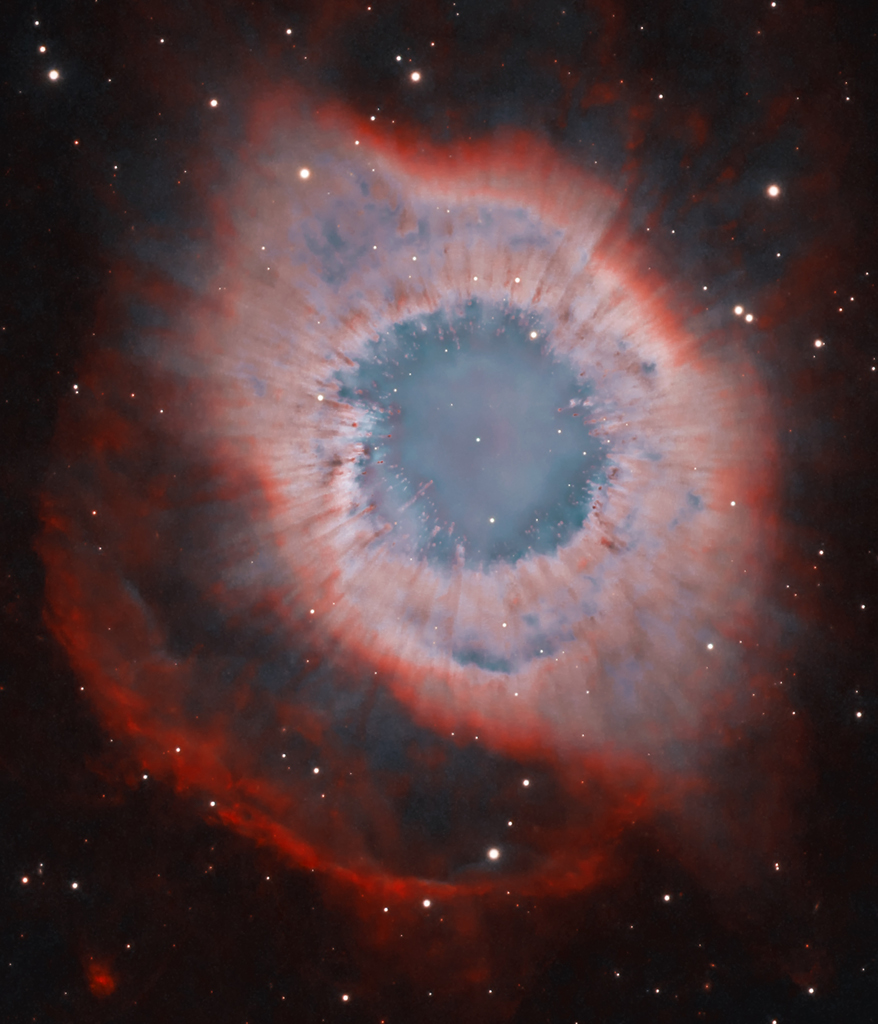
Helix Nebula

 See Explanation.  Clicking on the picture will download
the highest resolution version available.

This gorgeous photo of the Helix Nebula--a planetary nebula--is some 700 hundred light years from Earth. The white dot in the center is the star that blew up to create the nebula, which looks like an iris. (NASA)